By ENITAN ABEL JOHNGOLD ORHERUATA, mnipr
The Revenue Mobilisation Allocation and Fiscal Commission (RMAFC) on Monday intensified the national campaign to reduce Nigeria’s dependence on crude oil, launching a strategic assessment of Delta State’s economic diversification programme and declaring that the era of relying almost exclusively on petroleum revenues must give way to a more resilient, innovation-driven and productive economy.
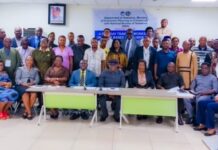
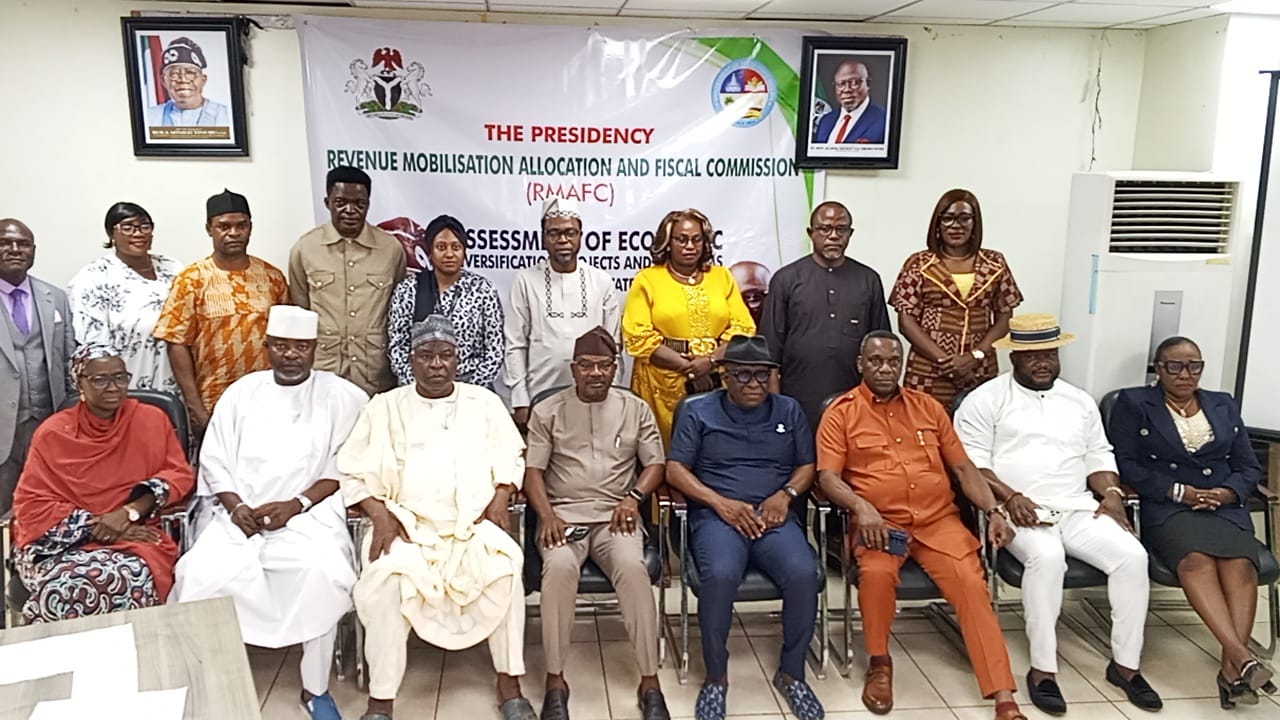
Leading a 14-member delegation of the Commission to Government House, Asaba, Chairman of the RMAFC Mobilisation and Diversification Committee, Hon. Victor Eboigbe, said the exercise was part of the Commission’s constitutional responsibility to guide governments at all levels towards building sustainable revenue streams capable of withstanding the uncertainties of the global oil market.
The assessment, he explained, is designed to evaluate Delta State’s policies, programmes and investments aimed at expanding non-oil revenues while identifying areas where the Commission can provide technical advice to strengthen fiscal sustainability.
Eboigbe warned that decades of overdependence on oil had repeatedly exposed Nigeria’s economy to external shocks, insisting that genuine prosperity would only come through deliberate diversification of the nation’s productive sectors.
“Mother Nature has blessed this country and Delta State with abundant human and material resources that should be harnessed for the benefit of the people,” he said.
“But the vagaries of the international oil market remain beyond our control. That leaves us with one glaring option, diversification. It is the pathway to sustainable economic growth, stronger revenue generation and enduring prosperity.”
He noted that the initiative aligns with President Bola Ahmed Tinubu’s Renewed Hope Agenda, which places industrialisation, manufacturing, agriculture, technology, digitisation, innovation and the creative economy at the centre of Nigeria’s long-term economic transformation.
According to him, although many Nigerians associate RMAFC primarily with revenue allocation, the Commission’s constitutional responsibilities extend beyond sharing the Federation Account.
Citing Paragraph 32(a) and (c) of Part I of the Third Schedule to the 1999 Constitution (as amended), Eboigbe said the Commission is specifically empowered to advise the Federal and State Governments on fiscal efficiency and practical strategies for increasing government revenues.
“Our advocacy for economic diversification derives directly from that constitutional mandate,” he said.
He recalled that the Commission had previously organised a National Stakeholders’ Seminar on Economic Diversification in 2024 as well as advocacy workshops across Nigeria’s six geo-political zones to encourage governments to broaden their economic base.
According to him, the current nationwide assessment serves as a follow-up to those engagements while also implementing a presidential directive aimed at accelerating economic diversification across the federation.
Eboigbe disclosed that the Commission had already provided relevant Ministries, Departments and Agencies in Delta State with comprehensive assessment templates and questionnaires, adding that the delegation would spend the coming days engaging critical stakeholders before developing recommendations to strengthen the state’s diversification agenda.
Expressing confidence in Governor Sheriff Oborevwori’s administration, he said the state’s willingness to subject itself to the assessment reflected a genuine commitment to building a more sustainable economy beyond oil.
Receiving the delegation on behalf of Governor Oborevwori, Delta State Commissioner for Economic Planning, Mr. Sonny Ekedayen, described the Commission’s visit as timely and strategic, stressing that RMAFC had come not to “share the national cake” but to help governments expand it.
“They are not coming to take from us,” Ekedayen said.
“They are actually coming to help us prepare for life outside oil. They are helping us ask the difficult but necessary question: what happens when oil is no longer the mainstay of our economy?”
He commended the Commission for initiating what he described as a forward-looking national conversation, noting that responsible governments must prepare today for tomorrow’s economic realities.
According to him, Delta State has already begun laying the foundation for that future through deliberate reforms aimed at expanding internally generated revenue without imposing heavier tax burdens on citizens.
Ekedayen disclosed that the state’s internally generated revenue had increased from about ₦83 billion when the Oborevwori administration assumed office to over ₦200 billion, attributing the remarkable growth to expanded tax coverage, improved efficiency in tax administration, stronger compliance and better enforcement rather than higher tax rates.
Beyond revenue reforms, he said the administration was aggressively pursuing commercial agriculture through innovative public-private partnerships that enable investors to provide capital and technology while government contributes land and host communities benefit directly from employment and profit-sharing arrangements.
He added that large-scale agricultural investments, particularly in cassava and oil palm production, would not only strengthen food security but also create thousands of jobs and significantly boost non-oil revenue.
Also speaking, Commissioner for Finance, Chief Fidelis Tilije, said the Oborevwori administration was positioning Delta as an industrial hub through strategic infrastructure investments, particularly in energy.
He revealed that Governor Oborevwori had directed that the Kwale Industrial Park be fully energised ahead of its inauguration, noting that investors had already begun indicating interest in establishing operations at the facility.
Tilije also identified the shallow navigation channel along the Forcados axis as one of the major constraints to maritime commerce but expressed optimism that stronger collaboration between the Delta State Government and the Federal Government would accelerate the revitalisation of Warri Port and other maritime assets capable of unlocking enormous trade, industrial and investment opportunities.
The RMAFC delegation is expected to conclude its engagements with key ministries and agencies before submitting recommendations aimed at strengthening Delta State’s transition from an oil-dependent economy to one anchored on diversified and sustainable sources of growth.