The African Action Congress (AAC) governorship candidate for the 2027 Delta State governorship election, Engr. Isaac O. Eshor, has declared that Delta State possesses the financial strength and human resources required to achieve greater development, insisting that the state’s current level of infrastructure does not reflect its enormous revenue capacity.
In this exclusive interview with UGOCHUKWU BENSON and CELESTINE ESE, Eshor spoke on his ambition to lead Delta State, his confidence in defeating the incumbent administration in 2027, the poor state of rural roads across the state, and his argument that governance should be based on competence rather than political arrangements.
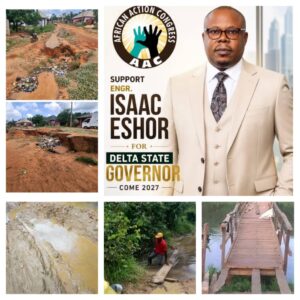
The maritime engineer, entrepreneur, and founder of the Focus Foundation expressed concern over what he described as the disconnect between Delta State’s financial resources and the realities experienced by many communities. He particularly highlighted the condition of rural roads, which he said has affected economic activities, especially agriculture, by making it difficult for farmers to transport their produce to markets.
Speaking on his governorship ambition, Eshor said he believes the electorate has the power to determine the direction of the state whenever a government fails to meet the expectations of the people. He argued that the wealth of Delta State should translate into visible development across communities, including better road networks and improved connectivity between towns and villages.
He maintained that his decision to contest under the African Action Congress was driven by his desire to provide an alternative leadership approach focused on competence, accountability, and effective utilisation of public resources.
On the contentious issue of zoning and equity in Delta’s governorship succession, Eshor argued that leadership in a democracy should not be restricted by arrangements that are not constitutionally binding. According to him, the people should have the freedom to choose leaders based on capacity, integrity, and the ability to deliver results.
In the wide-ranging interview, Eshor also spoke about his plans to open up communities through improved infrastructure, his confidence in his chances in the 2027 election, and his belief that Deltans will ultimately choose a leader with the vision and competence to move the state forward.
Can we meet you?
My name is Engr. Isaac O. Eshor, and I am a proud son of Ebu Town in Oshimili North Local Government Area of Delta State. I am a Maritime Engineer, entrepreneur, employer of labour, International Ambassador to Intercap Nigeria, Founder of the Focus Foundation, and the governorship candidate of the African Action Congress (AAC) for the 2027 election.
You are contesting for the governorship of Delta State under the African Action Congress (AAC). What makes you believe you can defeat an incumbent governor?
Thank you very much. It will not be the first time in Nigeria that a sitting governor has been defeated. In every democracy, the people remain the ultimate decision-makers, and when a government fails to meet their expectations, they have the constitutional right to vote for a new leadership. That is why I believe the 2027 governorship election should not be viewed simply as a contest between political parties or individuals, but as an opportunity for Deltans to assess the performance of the current administration and determine whether the state has made the level of progress that its enormous resources should ordinarily deliver.
Delta State belongs to all of us, and every community deserves to experience meaningful development. When I look at the huge resources and monthly allocations accruing to the state, I believe the present administration has performed below expectations. The level of infrastructure and development across many parts of the state does not reflect the enormous financial resources available to Delta State.
Let me begin with my hometown, Ebu, because charity begins at home. For more than 30 years, my people have lived without many of the basic social amenities they deserve. The major economic road linking Ebu with neighbouring communities has collapsed, leaving residents effectively cut off from surrounding towns. Today, the only practical access route is through the federal road via Illah, which is itself in a deplorable condition. This situation has made movement difficult for residents and has affected economic activities within the community.
The Ebu road was last constructed during the administration of former Governor James Ibori about three decades ago. Since then, successive administrations, including the present government, have not done enough to address the problem despite repeated appeals from the people. To me, that is a clear indication that many rural communities have not received the level of attention they deserve.
The challenge is not limited to Ebu alone. In Ashama, in Aniocha South Local Government Area, and in several other communities, there are virtually no motorable roads, forcing residents to depend largely on motorcycles for transportation. Similar infrastructure challenges also exist in Delta Central. The Orhoakpor–Ododegho–Ughelli Road in Ethiope East Local Government Area has remained in a deplorable condition for a long time.
I also visited Asaba-Ase through Uzere in Delta South and saw communities that still lack proper road links. Seeing those conditions strengthened my conviction that much more can and should be done. While the government has announced the construction of several flyovers, I believe Delta State has the financial capacity to execute those projects while also rehabilitating and constructing major roads that connect rural and urban communities across the state.
For me, development should not be concentrated in a few locations while many communities remain isolated because of poor infrastructure. With the level of revenue available to Delta State, including the state’s 2025 allocation of about ₦936 billion, excluding internally generated revenue, I believe it is possible to improve road infrastructure across the three senatorial districts. Delta remains one of Nigeria’s richest states in terms of federal allocations, and I believe those resources should translate into visible and balanced development that positively impacts the daily lives of ordinary citizens.
If elected governor, do you believe you can perform better than the present administration?
Yes, I do. I believe that with proper planning, accountability, and a clear understanding of the needs of the people, Delta State can achieve far more than what we are currently witnessing. My focus will be on ensuring that the resources of the state are directed towards projects that have direct impact on the lives of ordinary Deltans.
Within two years, I will prioritize opening up major link roads connecting neighbouring towns and villages because we have the resources to do so. Good roads are not just about transportation; they are the foundation upon which economic activities, social development, and community growth are built. When communities are connected by good roads, farmers can move their produce to markets easily, businesses can expand, and residents can access opportunities that improve their standard of living.
Today, many of our people are suffering because of poor infrastructure. Farmers, in particular, face serious difficulties transporting their agricultural products from rural communities to markets because of bad roads. In many cases, their efforts and investments are affected because they cannot easily get their produce to buyers. A government that understands the importance of economic development must first provide the infrastructure that allows people to thrive.
Infrastructure is the foundation of economic development. Without functional roads and proper connectivity, even the best economic plans will struggle to succeed. This is why my administration will pay serious attention to opening up communities and ensuring that rural areas are not neglected.
When you compare what states like Abia and Enugu are doing with the resources available to them, it raises serious questions about whether Delta State’s enormous financial resources are being effectively translated into meaningful development. In my opinion, the answer is no. Delta State has the capacity to do much more because of the resources available to the state.
My belief is that government should be measured by the visible impact it creates in the lives of the people. The goal should be to ensure that every community feels the presence of government through projects that address their real needs and improve their quality of life.
How do you intend to defeat the incumbent governor in the 2027 election?
Time will tell. Every election has its own dynamics, and I believe that the people of Delta State will ultimately determine the direction they want the state to go. At this stage, I will not disclose my campaign strategies because every political movement has its plans, approach, and methods of engagement with the electorate.
However, I want to make it clear that I am fully prepared and committed to the governorship race. I am not entering the 2027 election as a participant; I am in the race with the intention of winning. My decision to contest is based on my belief that Delta State has the potential to achieve much more than it is currently experiencing, especially considering the resources available to the state and the expectations of the people.
I believe that elections are ultimately about the confidence and trust of the people. When citizens evaluate the performance of any administration, they consider issues that affect their daily lives, including infrastructure, economic opportunities, and the overall development of their communities. My message to Deltans is centered on the need for leadership that understands their challenges and is committed to using available resources for meaningful development.
The people of Delta State have the right to make their choice based on the performance of government and the vision presented by those seeking to lead them. I believe that with the right engagement, a clear message, and a commitment to addressing the concerns of the people, Deltans will make the right decision in 2027.
I am consulting widely across the state, listening to the concerns of communities, and building relationships with people from different parts of Delta. The goal is to understand their needs and present a vision that reflects their aspirations.
For now, I will continue to focus on preparing for the election and presenting myself as an alternative leadership option for Deltans. The people will decide, and I believe that by 2027, they will choose the candidate they believe has the capacity, commitment, and vision to move Delta State forward.
Some people argue that Delta State’s governorship follows an equity arrangement and that it is now the turn of Delta Central to complete eight years after Anioma. What is your position?
Thank you very much. My position is very clear. Is that arrangement contained in the Nigerian Constitution? We operate a democratic system where every qualified citizen has the right to aspire to any political office, and the final decision rests with the electorate. While I understand the arguments being made around equity, fairness, and political balancing, I believe that leadership selection in a democracy should be based on principles that guarantee competence, capacity, integrity, and the ability to deliver good governance.
For me, the most important question should be: who has the vision, experience, commitment, and ability to move Delta State forward? The people of Delta State deserve leadership that will address their challenges and use the resources of the state for the benefit of all citizens, regardless of where they come from.
My party, the African Action Congress (AAC), does not believe in zoning or power rotation as a binding principle. We believe that democracy should allow all qualified individuals to present themselves to the people, while the electorate has the responsibility to assess the candidates and make their choice based on competence and credibility.
Delta State belongs to all Deltans. The governor of the state should not only represent a particular senatorial district or ethnic group; he or she should be a leader who understands the needs of every community across Delta North, Delta Central, and Delta South. The issues affecting our people, such as poor infrastructure, unemployment, and the need for economic development, require leadership that can bring everyone together and deliver results.
That said, I respect the views of those who believe in equity and political arrangements. Every part of the state has legitimate aspirations, and those concerns should be listened to. However, in a democratic environment, we must also consider the capacity of individuals seeking to lead and the ability of such individuals to provide effective governance.
I am consulting widely across Delta State and engaging with people from different communities. My belief is that Deltans are intelligent and understand the importance of choosing leaders who can transform the state. Ultimately, the people will decide who has the vision, competence, and commitment required to move Delta State forward.
The future of Delta should be built on fairness, inclusion, and good governance. While political considerations are part of democracy, the ultimate goal must remain the development and progress of the state and the wellbeing of its people.